banner


How To Set Initial Timing

Distributor Functioning

The benefactor of a typical engine has a lot more responsibility than but distributing the spark to the correct cylinder (which in itself is a feat). It is too triggers the gyre to release the high voltage, in many cases information technology turns the oil pump, it distributes the spark to eight different cylinders and it alters the timing of the organization. The benefactor could be the hardest working part of your ignition organization and this is why information technology is of import to ensure that your distributor is upward to the job of delivering the performance and power that you wait from your engine.
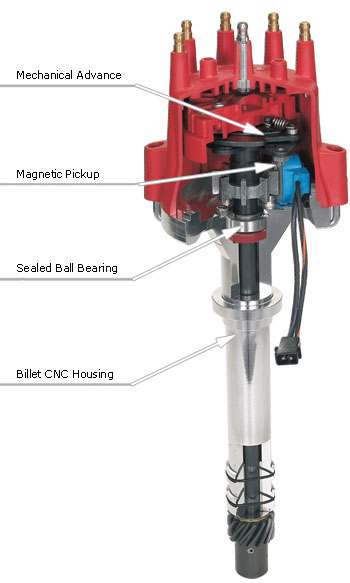
Distributor Cutaway

Distributors have changed over the years. From plastic to billet housing materials, trigger mechanisms, timing controls and other items accept all been modified over the years, yet most models will perform some if non all of the following duties:


  • Distribute the spark to dissimilar cylinders
  • Trigger the secondary side of the ignition
  • Alter the ignition timing
  • Driving the oil pump

Most distributors are driven by the camshaft through gears with a i-to-one ratio. (This means the benefactor turns at camshaft speed, or half of crank speed.) There are a 2 important parts attached to the shaft; a trigger bicycle and the rotor. The trigger wheel will vary depending on the type of trigger existence used, but you will notice that it will accept a tooth, or lobe or infinite for each cylinder of the engine. The rotor delivers the loftier voltage from the coil to the correct cap last. When the coil fires, the voltage is transferred through the coil wire to the center terminal of the distributor cap. This concluding contacts the center of the rotor, moves across the rotor and jumps across a pocket-size gap to the spark plug terminal of the cap. All of this occurs in fractions of a second and thousands of times.


Timing Settings

As your engine rpm and load varies, then does the need for your timing. At idle, a spark occurs on a piston's compression stroke a few degrees earlier it reaches TDC. At this point, the fuel mixture is ignited beginning the combustion procedure. The human action of combustion remains fairly constant but because the piston is travelling at a much higher speed, the initiation of the combustion procedure needs to occur sooner. Therefore the spark must occur more before in the pinch stroke to generate the best combustion and power results. To meet these demands, distributors are equipped with an advance mechanism that operates through centrifugal force.

This mechanical advance assembly is made up of two weights that are pushed out by the spinning forcefulness of the distributor. Springs are attached to these weights to control the charge per unit at which they are forced out past the spinning motion. The weights are mounted on an advance plate which is attached to the trigger assembly of the distributor then it moves forward resulting in the ignition existence triggered earlier (avant-garde).

By swapping different tension springs you can alter how apace the timing advances. A spring with less tension lets the weight spin out easier to advance the timing quickly. Many companies offer accelerate kits that consists of different weights and springs to fit a variety of distributors and so you lot can dial-in an accelerate curve to match your engine'southward needs.

The mechanical advance is an of import chemical element is tuning your engine. A slow advance can hinder functioning while also much accelerate can cause pre-ignition resulting a loss of ability or even engine harm. This is why it is important to check the timing at idle and at higher rpm and then you know what the total advance is at.

The advance assembly is mounted on tiptop of distributor shaft on all of MSD's distributors which makes changes fifty-fifty easier. To terminate the amount of accelerate, there is a cease bushing under the accelerate plate that tin exist replaced. This manner you lot have improve control, and an easier fourth dimension adjusting, over the total timing.
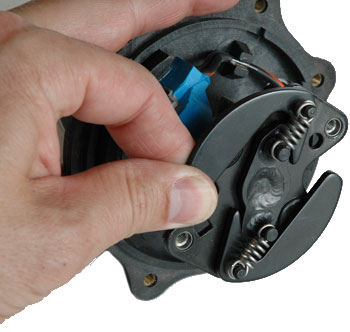
Mechanical Advance

The functioning of a mechanical advance assembly is based on the physics of centrifugal strength. As the distributor spins, the weights overcome the tension of the springs and push button out from the center of the distributor. This movement advances the trigger office of the benefactor, therefore the timing also advances.


Timing Terms

There are three timing terms yous'll hear during demote racing sessions; Initial timing, mechanical (or centrifugal) advance, and total timing.

Initial timing refers to where the timing is gear up at an idle. This is also where you position the distributor when setting the timing. Generally, this will exist six° or 12° or something lower, depending on the application.

Mechanical timing refers to the amount of accelerate that the weights, or advance assembly add to the initial. For instance, a benefactor may be set up to supply 21° of centrifugal advance.

Total timing is the term given to the highest corporeality of advance. This is when the initial timing is added to the mechanical timing. For instance, if an engine has 10° of initial combined with 21° of mechanical, the full timing is 31° BTDC. Annotation that Full timing never includes vacuum accelerate.

Timing Chart

This chart shows a typical timing set up with the initial set at 10° with the centrifugal advance starting to move at nigh 1500 rpm and reaching total timing 28° at 3500 rpm. (Meaning an 18° timing advance bend.)
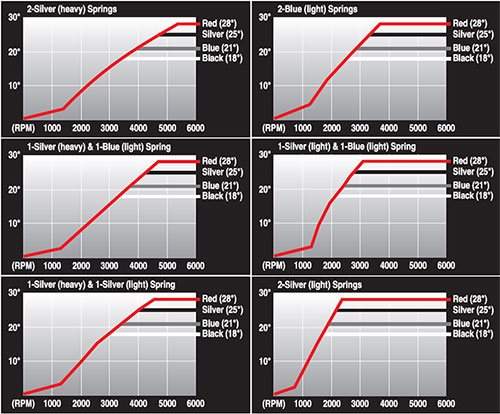
Timing Chart

Vacuum Accelerate

Vacuum advance is primarily used in an effort to improve economy, therefore you won't hear much about vacuum advance when discussing operation and racing. There is piddling to no vacuum during broad open up throttle which ways no vacuum advance any manner!

A vacuum advance canister provides a fashion to advance the ignition timing during moderate and function throttle conditions. This is when the load on the engine is less and vacuum is higher. In that location is a diaphragm within the canister which is connected to a linkage continued to the pickup plate in the benefactor. When vacuum is practical, the plate is pulled which advances when the trigger betoken is created. When the engine accelerates, vacuum drops so the advance returns to the original position.

When connecting the vacuum advance, almost applications connect to a port above the throttle plates. This is chosen ported vacuum compared to manifold vacuum which comes straight from the intake manifold. The deviation here is that manifold vacuum is in that location constantly while the ported source provides vacuum only when the throttle blades are open. The amount of advance that occurs varies by application simply generally ranges from ten°-15°. Some companies fifty-fifty offering an adaptable vacuum advance canister. This lets yous set the exact amount of vacuum advance that your engine requires.
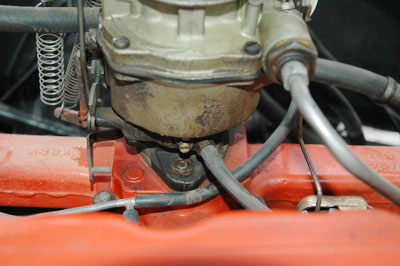
Stock Vacuum Advance

Most vacuum accelerate canisters are continued to a ported vacuum source (above the throttle plates on a carburetor). This way, in that location is only advance when the throttle is existence applied.

Adjustable Vacumm Advance

Some aftermarket vacuum canisters are adjustable through the vacuum port.

Timing Lights

Timing Light

Every bit with nigh tools, there are several versions of timing lights available, and they tin range from cheap to upwards of a couple hundred dollars. When you're shopping for a light, ask yourself what y'all're looking to accomplish forth how much y'all can spend. If you're simply going to be setting the timing occasionally on your street automobile yous may not need the super cool light with the latest gizmos and gadgets. If your engine strives on timing changes within a half a degree, stepping up to improve quality may be required.

MSD offers a couple dissimilar timing lights; a Standard Calorie-free and a Self Powered Light. Both have removable leads (for safety and storage) with clamp on pickups. The overnice thing virtually the Self Powered version is that information technology doesn't demand to be connected to the battery.


Timing Tapes

Timing Tape

You can have the brightest, most accurate timing light available, but if y'all don't have a clear timing marking on the balancer or pointer, it's non going to do you any good. Stock balancers will just have a timing line stamped at the TDC point for the number one cylinder, and so there'southward not much of a chance to check the full advance. MSD offers a Timing Tape PN 8985 that you apply to the balancer and so you lot tin can accurately check the total timing of your engine.


Timing Curves

The charts below show the multifariousness of timing curves available on an MSD Distributor simply past changing the advance springs and stop bushing.

MSD Timing Curves

Timing Curves

The charts beneath show the variety of timing curves available on an MSD Distributor merely by changing the accelerate springs and stop bushing.

MSD Timing Curves

1. Which Timing is Right for me?

The tricky thing near ignition timing is that i setting is just not ideal for the diverseness of different atmospheric condition an engine goes through. When information technology comes to achieving optimum torque and horsepower throughout the unabridged RPM range, the ignition timing curve is imperative. The timing that you demand during cranking and at an idle is not sufficient for loftier-RPM operation. Conversely, ideal high-RPM timing is not going to go over well during cranking or low speed performance. As RPM increases, the engine requires different ignition timing due to a list of changes that occur to the air/fuel mixture entering the cylinder. The principal reason is the reduction in fourth dimension that the mixture has to completely combust before the piston reaches tiptop expressionless center (TDC) due to its increased speed.

These statistics all need to be considered when y'all're looking for the optimum timing setting for your application. Many engine shops or manufacturers will be able to point y'all in the right direction when setting the timing. Testing and tuning are the all-time tools y'all can use:


Cistron Accelerate Timing for: Retard Timing for:
Cylinder Pressure level Depression High
Vacuum High Low
Energy of Ignition Low High
Fuel Octane Loftier Low
Mixture (Air/Fuel) Rich Lean
Temperature Cool Hot
Combustion Chamber Shape Open Meaty
Spark Plug Location Starting time Center
Combustion Turbulence Low High
Load Light Heavy

2. What practise you accept to supplant my points benefactor and what are the advantages with electronic versus points?

MSD does not have a module to replace the breaker points system in your stock distributor, however an MSD Ignition Control will work great with a points trigger ignition. In fact, if y'all replace the points when you install your MSD, you lot'll probably won't take to supervene upon or adjust them for years!

The MSD's trigger wire connects direct to the breaker points wire so when the points open up, the MSD is triggered. Since the MSD's capacitor is responsible for sending the spark energy to the coil, the points are only used every bit a trigger reference point. With this connectedness in that location is very little current crossing the points so the article of clothing is nominal at best. Also, the MSD controls the dwell and then the adjustment of the points is not that disquisitional either. This setup works groovy with street cars and budget racers, merely when you lot begin stepping upwardly performance more and more, the need for a quality distributor comes into play.

MSD's Pro-Billet Distributors are engineered to deliver precise trigger signals, provide accurate distribution of the sparks and are reliable. A magnetic pickup is used to trigger the ignition. Unlike points, this pickup is maintenance-free and is capable of authentic trigger signals throughout 10,000 rpm.


3. What is the best spark plug gap for my application?

The spark plug is the point in the ignition system where electrical energy is converted into heat, consequently, the larger the gap the greater the amount of heat available to lite the air/fuel mixture. Nevertheless, also large of gap combined with increased cylinder pressures tin put excessive pressures on the initial voltage needed to ionize (cross) the gap. Finding the optimum plug gap for your application is best adamant by experimentation because there are so many engine variables to consider.

An MSD Ignition Command has enough output power to consistently fire wider spark plug gaps on a performance engine. As a starting point, follow the engine builder or manufacturer's recommendation for the plug gap. With that, y'all tin can experiment with increasing the gap until the best performance is establish.

As a rule of thumb, it is recommended to increment the plug gap by .005" - .010" followed by testing and tuning. Proceed in mind that larger spark plug gaps besides place increasing demands on the secondary portion of the ignition system including the distributor cap and rotor, coil wire, and spark plug wires. They should all be in superlative condition and checked periodically during the race flavor. Remember that electricity takes the path of least resistance to a ground and so if the gap is too large the spark may short to another bespeak with less resistance.


4. What'due south the differences between a Capacitive Belch (CD) ignition like an MSD and my stock ignition system?

The biggest difference is that the majority of stock ignitions are anterior ignitions. Inductive ignition systems are used due to their simplicity and inexpensive product. For stock applications these ignitions are adequate, only when it comes to gaining performance, manufacturing plant inductive ignitions autumn short.

The chief weak link of a stock ignition is because the scroll serves double duty. The curlicue must human activity as a step-up transformer to create a college voltage spark, plus information technology needs to store this power until the ignition is triggered. As engine rpm increases in that location isn't enough fourth dimension to completely pace-up the voltage before the ignition is triggered resulting in a weaker spark. This low voltage spark may not be enough to low-cal the fuel mixture in the cylinder which will consequence in a misfire and loss of power.

A CD ignition, like an MSD half dozen Series, is capable of producing full power sparks throughout the entire rpm range. Information technology draws its free energy directly from the bombardment where a custom wound transformer steps information technology up to over 460 volts. This voltage is then stored in a capacitor until the ignition is triggered. At this indicate, all of the voltage is dumped into the coil where it is transformed into even more voltage, anywhere from xxx,000 - 45,000 volts depending on the coil, which is sent to the distributor and finally to the plugs.

The ability to produce high power sparks throughout the entire rpm range of your engine is why you lot need a CD ignition. The payoff is complete combustion of the fuel mixture which results in more power, increased throttle response, a smooth idle, quick starts, improved economy and reduced plug fouling.

All engines will benefit from a CD ignition simply when you lot're planning on engine modifications, the demand for an MSD Ignition increases. In detail, if yous're planning these types of engine modifications, you should be installing a CD ignition:


  • Improving air catamenia into the engine or richening the fuel mixture (rejetting or larger injectors)
  • Calculation a super/turbocharger or a nitrous oxide organisation
  • Increasing the compression ratio and consistent loftier rpm functioning

5. Why does an MSD produce multiple sparks and what are the benefits?

Conventional CD ignitions supply one spark of intense energy but for a short duration (time). An MSD uses multiple sparking engineering to take advantage of the quick rising time and power of a CD Ignition past producing a series of sparks. More sparks equal more than heat in the combustion bedchamber resulting in complete combustion of the fuel mixture which produces more than power. At lower rpm, there are many benefits to multiple sparks including a smooth idle, improved throttle response plus the spark serial prevents fouling plugs or fuel loading upwardly in the cylinder when air/fuel distribution is poor.

The multiple spark series of an MSD Ignition Command lasts for 20° of crankshaft rotation. At lower rpm, 1,000 rpm for example, at that place is plenty of fourth dimension to burn down the plug a number of times to ensure ignition of the fuel mixture. As rpm increases, the piston travels up on the pinch stroke faster resulting in a shorter corporeality of fourth dimension available to fire the plug so the number of sparks that occur decreases. Past virtually 3,000-three,300 rpm, in that location is only enough time to fire the plug once. From nigh this rpm range on, an MSD ignition control delivers 1 intense, full power spark.


6. What size battery do I need if using an MSD ignition?

The battery is the fuel tank for the ignition system (magnetos excluded). When it's empty there is no electric power available for the ignition system to convert into heat at the plug gap. In long duration racing events such as circle track racing, an alternator is highly recommended. In elevate racing, a charging system is not a complete necessity as long as you have a good bombardment and charge it in between each round. Likewise continue in mind that electric fuel and water pumps, fans and solenoids eat upwardly a lot of current equally well.

Race cars without charging systems must have a bombardment with a large enough capacity to power all the electrical parts. For example, an MSD 6 or 7 series ignition consumes approximately one amp per thousand rpm, so at 5,000 rpm the MSD alone is using v amps. An MSD is designed to produce full power sparks with a supply voltage of 10 volts, only if the supply drops below that, ignition output volition suffer.

An MSD can be used with sixteen volt batteries, but no performance gain will occur because the output power of the MSD is regulated. The reward of a sixteen volt battery is increased electrical capacity. For more data on battery requirements with an MSD, ask your MSD Customer Support Tech for our Bombardment Tech Message.


7. How practice I fix:

  • A high rpm miss when the engine is nether load?
  • An rpm limiter that seems to activate at the wrong rpm?
  • Erratic operation of electronic devices/ECUs?
  • A tachometer needle that seems to "bounce"?

All of the above tin be caused by Electro Magnetic Interference (EMI) generated by the ignition system. Specifically through the coil and spark plug wires. The ignition arrangement is a miniature power station and the spark plug wires are its transmission lines. The wires (in particular, "solid core" wires) can broadcast EMI that seeps into electronics and causes erratic behavior.

To gainsay EMI you need to run a set of helically wound spark plug wires such as MSD'due south Heli-Core or viii.5mm Super Usher Wires. Having the conductor wound around a special eye core produces a "choke" that holds EMI inside the wire. Solid core wires on the other hand, take no suppression capabilities and should not be used with an MSD Ignition. MSD'south Super Conductor Wires take extremely low resistance (less than l ohms per human foot), yet are designed to suppress EMI like a high resistance wire.

Other steps to avoid EMI issues include routing your coil'due south master wires away from other plug wires. The magnetic pickup harness coming from the distributor or crank trigger should be routed away from other wires and is a expert idea to take it mounted along a metal surface that will act as a ground plainly. MSD too offers a half dozen feet long shielded mag pickup cable, PN 8862, that can be used if you are having issues with EMI interfering with other electronics on your vehicle.


Source: https://www.holley.com/support/set_your_timing/

0 Response to "How To Set Initial Timing"

Post a Comment

Iklan Atas Artikel

Iklan Tengah Artikel 1

Iklan Tengah Artikel 2

Iklan Bawah Artikel